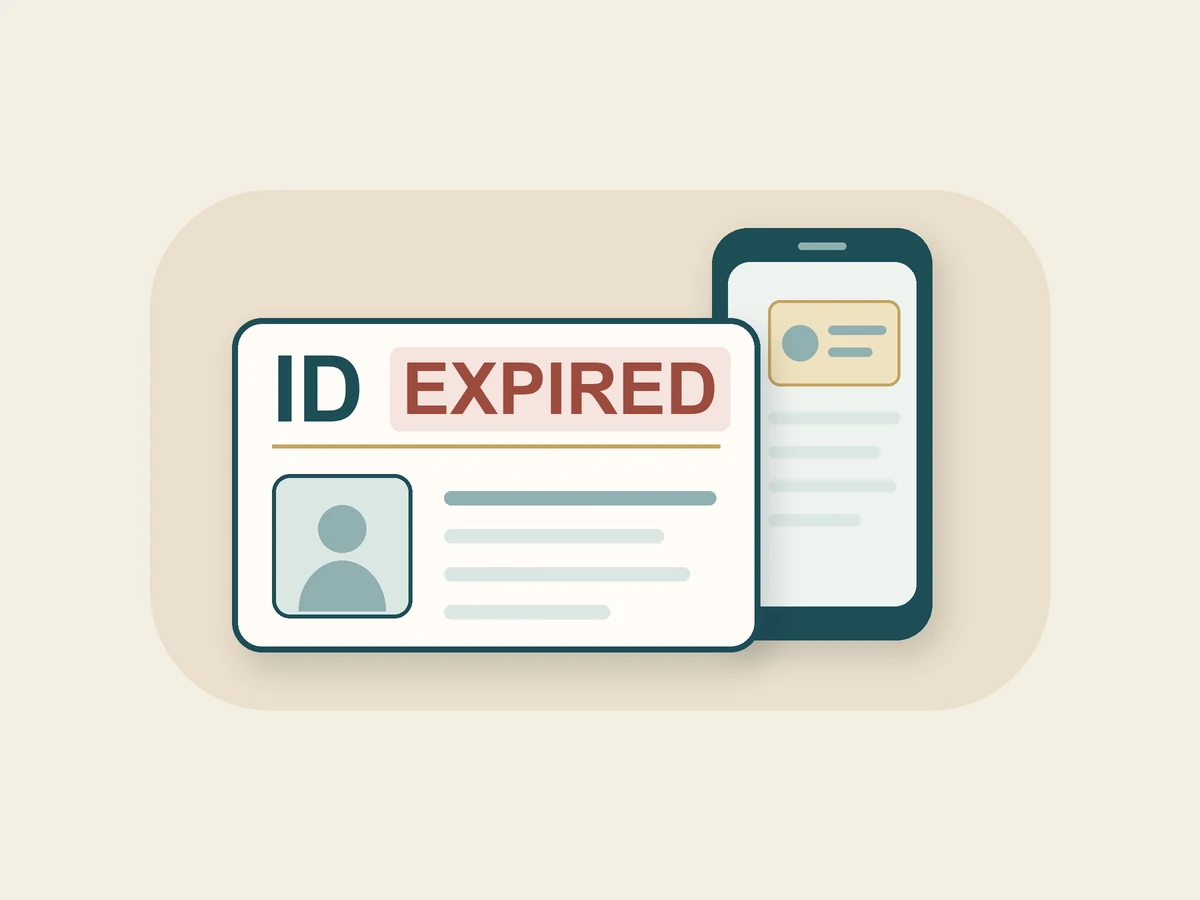
An expired Civil ID and an unfinished employer file do not by themselves decide whether you can leave Kuwait or return. Ask the Ministry of Interior what residence article and status are recorded for you, and your employer which action has actually been filed.
CONTENTS
Build a record of the four states
| Record | Where to confirm it and what to note |
|---|---|
| Physical Civil ID | Note the printed expiry date and whether a renewal has since been completed. Ask PACI about the card-renewal requirements and charges. |
| Residence record | Ask MOI residency services and the sponsoring employer for the residence article, validity or expiry information and sponsor on record. Note when and how the information was confirmed. |
| Kuwait Mobile ID | Record the app’s activation message and whether its data has been updated after a Civil ID renewal. Use PACI’s FAQ for the update instructions. |
| Employer transaction | Ask the employer which operation is pending, which office holds it, and what was submitted or approved. Keep any filing date, reference and supporting reply. |
When the app displays “Your Mobile ID is not active,” PACI’s FAQ distinguishes two situations. If the Civil ID has expired and has not been renewed, it instructs the user to renew the card before pressing Update. If renewal has already been completed, the next instruction is to press Update. This describes updating the identity app after card renewal; it supplies no residence-renewal procedure.
Keep the app record alongside the residence record rather than treating one as confirmation of the other. PACI’s FAQ does not establish how Mobile ID eligibility or its displayed information relates to residence validity. It also does not give the expatriate card-renewal prerequisites, fee or processing time; ask PACI for the requirements that apply to your card.
PACI accredits Kuwait Mobile ID as a legal digital identity that can substitute for the physical card, and says its e-services can be used abroad. These identity-service statements do not answer the immigration or carrier checks for your trip. Confirm the actual acceptance of Mobile ID with MOI and your booked airline, including the return journey if you plan to come back.
Identify the employer’s actual transaction
Ask the employer to identify the operation precisely: residence renewal, a transfer, cancellation or another action. Then separate the documents available, an application actually submitted and an official decision completed. A document list or a general progress update does not by itself establish those later stages.
MOI publishes distinct procedure pages for Article 18 renewal and cancellation. The renewal list includes a sponsor-signed application, the sponsored person’s original passport and a work permit issued by the Public Authority for Manpower (PAM) or its system record, among other items. The cancellation list includes the original passport and Civil ID, as well as PAM’s work-permit cancellation form. These are examples from the published lists, not complete instructions for every residence category or proof that your file has been processed.
Ask the sponsoring employer and MOI which current procedure and material list apply to your case. The pages do not supply a fee or timeframe, or settle whether renewal can finish while you are overseas or cancellation can be handled after departure. Do not infer a required sequence of work-permit, residence and card actions from these two lists.
An exit-permit request is another item to identify in the work file. In June 2025, PAM announced that private-sector expatriate workers must obtain an employer-approved exit permit before leaving Kuwait, with the requirement effective from July 2025. Its service announcement specified Article 18 workers requesting it through Sahel, with the employer reviewing and approving through Sahel Business. The approved request form includes personal details and a travel date.
For a job change, ask PAM and the employer of record about the present permit options, its validity and submission window, and which employer can approve while a transfer is pending. The announcements do not resolve these details or distinguish temporary travel from final departure. They give no alternative approval route when an employer refuses; do not assume that submitting a request means permission has been granted.
A planned return and a permanent departure
For a trip with a planned return, use your travel dates and residence category to ask focused questions:
- MOI’s General Department of Residency Affairs: What residence status and sponsor are recorded for this case? What current period outside Kuwait applies to the residence article, and is any absence permission relevant to the proposed return date?
- The employer and PAM: What exit-permit or other work-file action is needed? Is it submitted, approved or still pending? How do unfinished renewal, transfer or cancellation actions affect the plan?
- The booked airline: What documents does it require for the actual outbound and return routes? Will it accept Kuwait Mobile ID in the circumstances described?
This guide does not establish the current Article 18 limit for time outside Kuwait or the applicable absence-permission route. Ask the residency department what applies to your category and proposed return date.
For a permanent departure, ask the sponsor and MOI whether cancellation or another action is required, who handles it and how its timing relates to departure. The Article 18 cancellation page does not establish that cancellation must come before travel. It also leaves the fee, timeframe and possibility of processing after departure unanswered. If dependants are under your sponsorship, ask how their files will be handled too; their passports and original cards appear in the published cancellation list.
Have the details relevant to the question ready—such as nationality, residence article, recorded sponsor, route and proposed dates. This is a useful preparation aid, not a uniform official document checklist. Record which party answered each question and the basis of the reply.
Record each answer, and check fines correctly
Keep a short reply record: who answered, when, the operation or case reference, its status and any supporting confirmation. For a deadline, record the event from which it starts. For a charge, ask for the action it covers, amount and unit, payee and who pays it. Those details make it easier to compare replies without treating a progress report as an approval.
Keep card-renewal charges, work or residence transactions and recorded fines distinct. Obtain the amount for the actual action from the responsible office; amounts repeated in a forum or older figures are not a quote for your case.
MOI’s Immigration Fines enquiry is under Pay Fees. Its Residency option is selected by default and uses a 12-digit Civil ID. Selecting Visa changes the label to Visa Number, with validation for 6–9 characters. These are the published input rules. The page does not explain how an enquiry result establishes a payment outcome, residence validity or permission to travel. Ask MOI for those case-specific confirmations.
Useful verification pages are PACI’s Mobile ID FAQ, MOI’s Article 18 renewal and cancellation pages, and its Immigration Fines enquiry. The employer/PAM permit process is documented in the June 2025 service announcement; confirm its current details with the service and the employer.