Photo from Wikimedia Commons
Cut the optional overnight that requires its own base change first, but test the usable block it leaves before you remove it. Keep the must-sees and the fewest bases that serve them, and cost each move door to door rather than by its quoted ride. The parts a quoted journey leaves out—access, waiting, arrival, rest—can decide whether the night earns its place.
Photo from Wikimedia Commons
CONTENTS
Start with what the trip is for, then count bases
Before allocating nights, sort every proposed stop into one of three roles: a place that justifies the trip, a base where you sleep, or an optional addition that competes for the same hours as a must-see. The roles are not the same. A place can be worth visiting without deserving a hotel; a town can be a useful base without being the reason you came. Write the must-sees first, in the traveller’s own words, and keep them visible while the rest of the plan is trimmed.
Each additional base buys a movement and a settling-in period: pack and check out, get to the station or terminal, wait, travel, find the new hotel, check in, unpack, and recover. That cost is paid once per base change, so it takes a larger share of a short stay than of a long one, but it does not on its own decide whether the stay is worth making.
Then separate booked nights from usable time. Three consecutive nights do span two full calendar days between the first arrival and the final departure, but that is elapsed time, not visit time. A late arrival can erase the first evening without shortening the next day; an early departure can take the last morning. The usable block is what remains between the actual arrival and departure commitments after sleep, meals and other commitments, and it has to be calculated rather than inferred from the number of nights.
The first candidate for removal is the optional stop that adds a base and returns only a short usable block. The overnight that exists only to break a long journey is a different case: it may be doing real work for the driver or the group’s rest, and it should stay if the rest of the plan still fits around it. If an experience matters, check whether it can be visited from a base you are already keeping; do that only after confirming the connection and timing, because a day visit is an option to test, not a universal substitute for staying over. The aim is not the shortest list of places but the fewest base changes that still protect what the traveller came for.
Build one door-to-door account for each move
The figure in a timetable or on a ticket page answers a narrower question than the one a traveller is asking. Build one account per move, from the moment packing starts to the moment everyone is settled enough to go out, and keep the components visible.
| Component | What to record | Your figure |
|---|---|---|
| Preparation and packing | Packing, check-out, luggage storage or collection | |
| Access to the departure point | Walk, taxi, metro or shuttle to the station, terminal or airport | |
| Formalities | Ticket check, security, check-in or bag drop where they apply | |
| Residual waiting | Time left after formalities and before the vehicle leaves | |
| Main journey | The quoted ride or drive, with its conditions | |
| Onward access | Station or terminal to the next hotel or site | |
| Arrival and settling in | Check-in, luggage, room and orientation | |
| Recovery to readiness | The rest needed to finish the move and be ready to go out |
These are components to check, not fixed durations, and some overlap in practice. A shuttle may cover access and arrival in one line; a long wait may double as a meal; a quoted transfer may already include the walk to the car. Count the time once, in the row where it is actually spent, and note when an activity sits inside a quoted journey. If a value is unknown, leave it as “to check” rather than entering zero, and add a range only when you can say what sets its lower and upper ends.
Fill the account with commitments you already have: the flight arrival, the rental-car pickup, the last sensible check-in, the next booked activity. The account ends when everyone is settled enough to go out, not when the vehicle arrives, and it begins when packing begins, not when the front door closes. Recovery needed to reach that settled point is part of the completed move and is counted there; it should not be deducted again. The interval from that point to the next fixed departure is calendar time, not visit time. Sleep, meals, later rest and other commitments still come out of it, and the usable visit block is what remains.
Recovery is a line in the account, not a luxury. Some travellers need more than the timetable suggests—a driver facing a long leg, a group travelling with young children—and no universal number applies, but each needs an honest entry. Weather, traffic and queues belong to the main journey as conditions, not as rounding errors.
October by public transport: the Ephesus question
The first example is a twelve-night October proposal: Istanbul three nights, Selçuk/Ephesus two, Pamukkale one and Antalya six nights. Istanbul, Pamukkale and Antalya were the traveller’s musts, with Antalya reaffirmed; Selçuk/Ephesus was optional. The plan began with a flight from Istanbul to İzmir and continued by ground, so this is not a bus-only itinerary. Those nights are a historical proposal, not a current schedule.
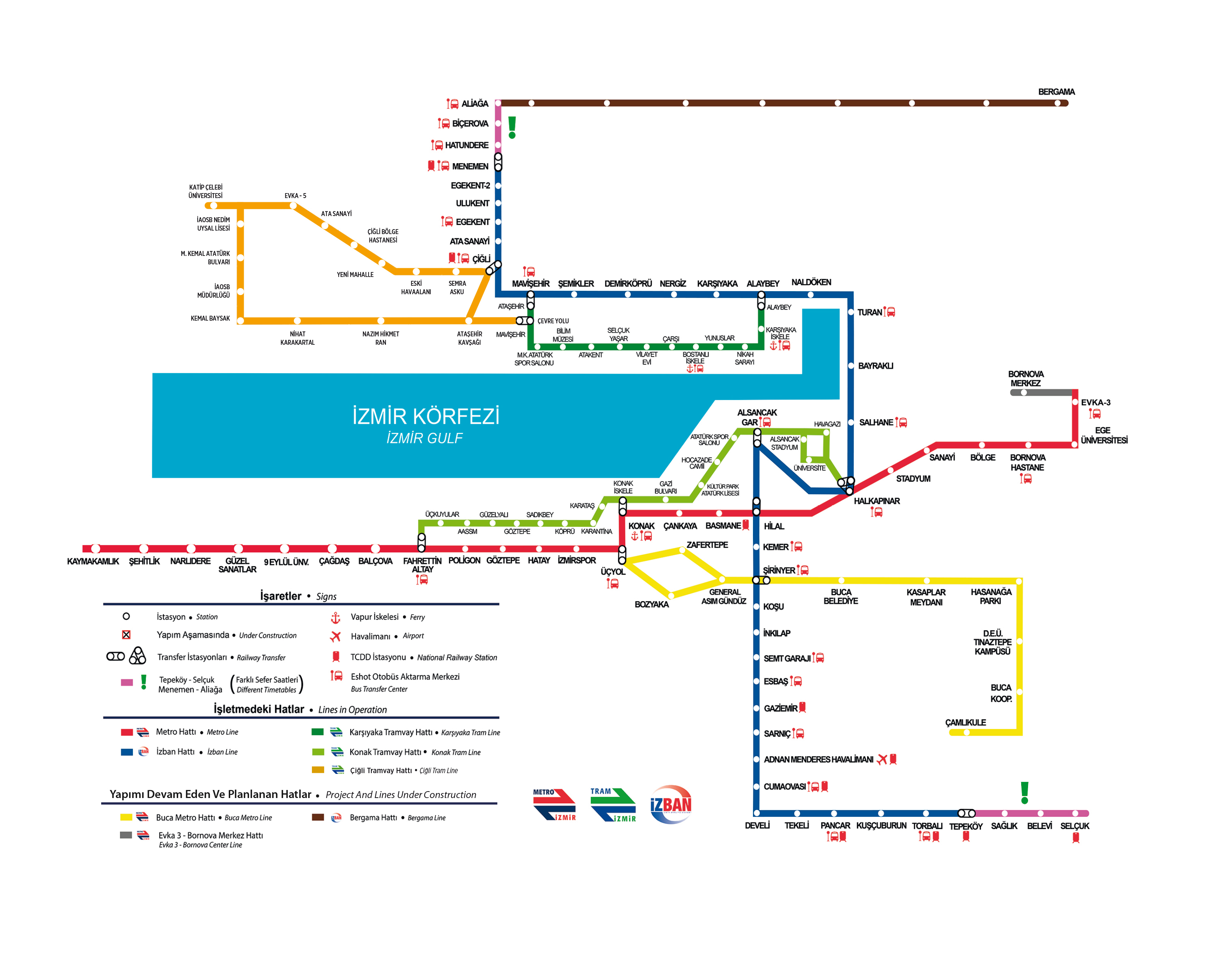
The airport-to-Selçuk leg is where that optional base first needs a real answer. İZBAN’s official network map is undated—viewed on 25 October 2026, it puts Adnan Menderes Havalimanı station and Selçuk station on one corridor south of İzmir, with Tepeköy marked as the railway transfer station and the Tepeköy–Selçuk section on separate timetables. That much establishes a rail line, not a usable connection: through-running, ride time, frequency, first and last departures and the Tepeköy wait all remain to be confirmed from a dated İZBAN or TCDD timetable for the travel date. The map also stops at the stations. It cannot show the walk or local ride from the airport terminal, or from Selçuk station to a hotel or the Ephesus entrance, so both ends remain separately unverified.
The coach leg answers a narrower question still. Pamukkale Turizm’s route page, also viewed on 25 October 2026, sells Denizli–Antalya bus tickets and carries an undated FAQ estimate of approximately 265 km and 3 hours 30 minutes, varying with weather and traffic. That is a ride estimate between two cities, not a door-to-door time: the page gives the cities as endpoints, with the terminals still to confirm, and it leaves out reaching the Denizli terminal, waiting, the Antalya transfer, luggage and hotel administration. It is not a driving time either. The operator says route, rest stop and travel time for a given departure appear in its app or site search, so a date and departure have to be checked there.
Two links in the same chain remain unverified: the connection from Selçuk to Denizli or Pamukkale, and local access between Denizli and Pamukkale (Hierapolis), which is a separate place from the city. That matters most for the one-night Pamukkale stop. Until the Denizli arrival time and the local access to the site are known, the stop’s usable block cannot be calculated; after sleep and meals, it might leave an afternoon, or very little. The stop protects a must-see, but it needs its own timing check before it can be treated as a sightseeing day.
For Selçuk, the choice is not between Ephesus and no Ephesus; it is whether the two nights and the extra base earn their place. Keeping the base leaves the site within reach if the airport chain and local access work; removing it cuts a move and a check-in, while a visit from another base remains an option only if its own connection and timing check out. Neither version comes with a verified complete onward connection, so availability and hours saved cannot be promised. The optional two nights are therefore the part to test first—not Antalya, which the traveller reaffirmed—and any time released belongs wherever the traveller most wants it. Confirm the open links above for the travel date with the relevant transport operators before committing; neither the undated map nor the undated FAQ can settle them.
November by car: stops, hotels and the driver’s day
The second example is a separate early-to-mid-November twelve-day road trip for a family of four on their second visit to Turkey. Their proposed sequence was Istanbul arrival, Çanakkale, İzmir, Antalya, Cappadocia, Yedigöller and back to Istanbul; that is context, not a recommended route. They were weighing an İzmir overnight and extra coastal stops for views rather than swimming, and their ages and rest needs still have to be established.
A sightseeing stop and a new hotel are separate decisions. A viewpoint, a short walk or a meal stop can fit inside a driving day without changing where the family sleeps; an overnight adds the full base-change cost described above. The question for each addition is not whether the place is worth seeing, but whether the stop and any night it requires still leave the visit block the family came for.
This proposal does not establish driving times or distances, and no town on the list is confirmed as on-route or as a detour. Each leg needs a dated route query using the family’s actual access points, chosen stops, the driver’s rest needs and the next fixed arrival—a hotel check-in, a flight or a booked activity. A route that looks short on a map can consume a morning once parking, getting four people out, meals and toilets are added. If young children are in the group, their patience and the driver’s day become the binding constraints; whatever the ages, distance alone captures neither rest nor patience.
Yedigöller, Lake Abant and the Atatürk Arboretum are distinct places, and a date around 12 November does not establish peak foliage or access. Seasonal conditions and access for the intended visit have to be checked with the area’s official source for that date, not inferred from the month. If foliage is the reason for the stop, that check decides whether it belongs at all.
Use the same account for the car. Write the drive, the stops, the driver’s rest and the arrival commitment for each day, then look at the visit blocks that survive. If an optional addition—the İzmir overnight, a coastal detour, a foliage stop—crowds out a chosen visit, remove or postpone it and reassess the rest of the plan. That is a decision sequence, not a verdict on any named place; the route should be rebuilt from confirmed timings rather than from a list of desirable names.