Photo from Wikimedia Commons (2022)
Pick a home by testing two real journeys from that address, not by choosing an area. Confirm how your employer's shuttle covers your shifts and how your partner would make their trip. Station and district names say nothing about the walk from a front door.
Photo from Wikimedia Commons (2022)
CONTENTS
Pin down both commutes before you shortlist addresses
Sabiha Gökçen Airport (SAW) and İETT list public bus routes to the airport. Those pages do not establish your employer’s shuttle stops, departure times, eligibility, overnight coverage or contingency arrangements. Ask the person who manages the shuttle which stop serves each candidate address, which departures fit your shifts, and how you would get home after work.
Your partner needs a separate route based on their exact workplace and working hours. Useful M4 connections include: Ayrılık Çeşmesi for Marmaray, Ünalan for the Metrobüs, Kozyatağı for the M8 Bostancı–Parseller metro, and Kadıköy for the T3 Kadıköy–Moda tram and ferries. Test the one that fits your partner’s destination rather than a line that merely looks convenient on the map, and confirm Marmaray’s timetable, stations and late-night service with the Marmaray operator before either of you builds a commute on it.
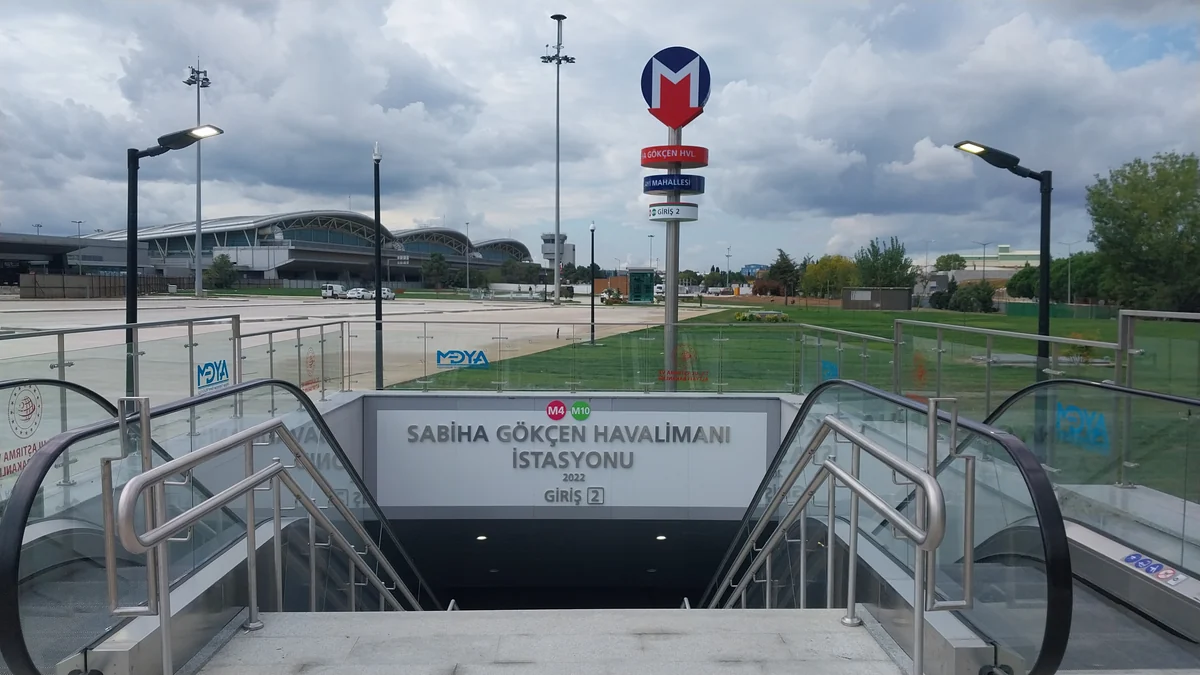
At the airport end, the M4 station has three entrances: No. 1 Domestic Terminal CIP Hall & Carpark, No. 2 Sabiha Gökçen Airport Hotel and No. 3 Terminal. Which one your shift uses depends on where you work inside the airport and where staff enter, so ask before you count the station as your commute.
Test an address, not an area name
The M4 runs between Kadıköy and Sabiha Gökçen Havalimanı, and stops such as Maltepe, Kartal, Pendik and Kurtköy mark where trains stop. That is line infrastructure, not a map of where people live: the station list says nothing about the walk from a particular flat, the bus routes on its street, or which district an address belongs to.
Names can overlap without describing the same place. Kurtköy station sits between Yayalar-Şeyhli and Sabiha Gökçen Havalimanı, while İETT’s airport-access page, dated 23 June 2022, uses Kurtköy in route names such as 133K “Kurtköy Sanayi Mahallesi / Kavakpınar – Kartal”. Sharing a name does not put a stop beside the station, and a route name does not establish that the route still serves the airport. The same caution runs the other way: the M4 list has no station named Tuzla, Zümrütevler or Altayçeşme, and a missing name says nothing about how an address in those areas is served.
Entrance names carry no distance either. An exit named for a neighbourhood shows which side of the line it serves, not the walk from a home in that neighbourhood, and the station list does not assign neighbourhoods to districts or draw their boundaries. Treat a district label as a name, not as an access guarantee.
For each address, check the entire outward and return route, including the walk to every station, public-bus stop or employer-shuttle stop you would use. If you will not drive, confirm that your chosen transport and these connections work at your actual travel times. A familiar station or district name cannot make up for a missing connection.
Compare rent and daily needs at address level
Use actual property quotes for the cost comparison. TCMB’s New Tenant Rent Index (Yeni Kiracı Kira Endeksi, 2023=100) was 324.9 for Istanbul in August 2026, up 34.5% from a year earlier and 4.9% from the previous month. That figure tracks how fast new-tenancy rents moved across the province; it is not a lira rent, not a district or neighbourhood level, and it cannot price or rank Kartal, Maltepe, Pendik, Kurtköy or Tuzla.
The cost side of the comparison therefore comes from the addresses themselves. Set the household’s budget ceiling first, then record for each candidate what the listing asks, what the site maintenance fee (aidat) adds, and what both commutes cost in time, fares and transfers at the hours each of you actually travels. Add the household’s regular destinations beyond the two workplaces: an address that shortens one commute can lengthen every other repeated trip, and access to those destinations has to be judged from the address rather than from a district’s reputation. Compare the addresses that survive both the budget and the journey tests — the usable ranking is the one built from your own figures, not from an area average that cannot be checked against a particular flat.
Keep journey times, service windows, entrances and fares separate
| What to check | Published information and limits |
|---|---|
| Standard M4 service | 06.00–00.00. Outside the Friday-to-Saturday and Saturday-to-Sunday nights, the standard published schedule does not cover 00.00–06.00. Check Metro İstanbul’s announcements for temporary changes. |
| Weekend night service | M4 is listed for Friday-to-Saturday and Saturday-to-Sunday nights, with continuous operation starting Friday 06.00. The cited page gives both a Sunday 00.00 endpoint and a 66-hour total; these conflict, so the exact Sunday endpoint remains unconfirmed. That page does not give night-time frequency. |
| Card charges during Gece Metrosu | Validation from 00:30 is charged double under the card’s tariff; normal charging returns at 05:30. These charging boundaries do not establish when trains run. |
Check the dates and actual boarding times of both your outward and return journeys against the service rows. For a Sunday trip near the uncertain endpoint, confirm that specific journey with Metro İstanbul; do not calculate an end time from the fare rule or the 66-hour total.
An operating station may have closed entrances. During Gece Metrosu, the entrance list marks the airport station’s No. 1 (İç Hatlar CIP Salonu – Otopark) closed and No. 2 (Hotel) and No. 3 (Havalimanı) open. At Kurtköy, No. 1 (Hastane) is open and No. 2 (Ankara Caddesi) closed. An entrance restriction does not establish a station or line closure, and a different open entrance may require another walk; verify that leg for your particular address.
The PDF is undated in its text, has a server Last-Modified date of 4 December 2024, and was linked from the Gece Metrosu page at the 5 October 2026 evidence check. Confirm entrance status before travelling. Metro İstanbul is the contact for public service and entrance changes; your employer confirms staff access and private shuttle arrangements.
Build a fallback for each journey
When the shuttle cannot run, the alternative has to cover the journey at that hour, overnight included, and it may use a different stop or access leg than the shuttle does — what matters is that the replacement is verified for your own trip. Whether overnight shifts are covered at all belongs to the same question, because a fallback that exists only in daylight does not help a journey that begins in the small hours.
Public routes can fill gaps, but the pages that list them do not give the times you would need. Sabiha Gökçen’s public-bus page is undated and carries no timetables; among its routes are E10 Kadıköy–Kurtköy–Sabiha Gökçen, 16S Sabiha Gökçen–Metrobüs Uzunçayır and 132H Pendik YHT–Sabiha Gökçen. İETT’s night-lines page, also undated, lists E-10 Sabiha Gökçen Havalimanı / Kurtköy – Kadıköy as a night line; KM13 Tuzla – Pendik Metro/YHT/Pendik and UM73 Sabiha Gökçen H.L./Sultanbeyli – Necip Fazıl Metro appear on it too, with the note that as night lines they run only on Saturdays. What those pages do not say is when E-10 runs at night, how often it comes, or whether any night stop is near your address.
So treat a listed route as a candidate for one journey. Match it to your own stop, direction and day of travel, and check the stop itself rather than a place name that appears in the route’s label. If the partner’s fallback would use Marmaray, confirm its hours and late-night service with the operator. Metro İstanbul announces line-specific schedule changes on its Duyurular page, so check it before a journey that depends on the metro. A route becomes a fallback only once you have tested it for the exact trip it has to cover.