Photo from Wikimedia Commons
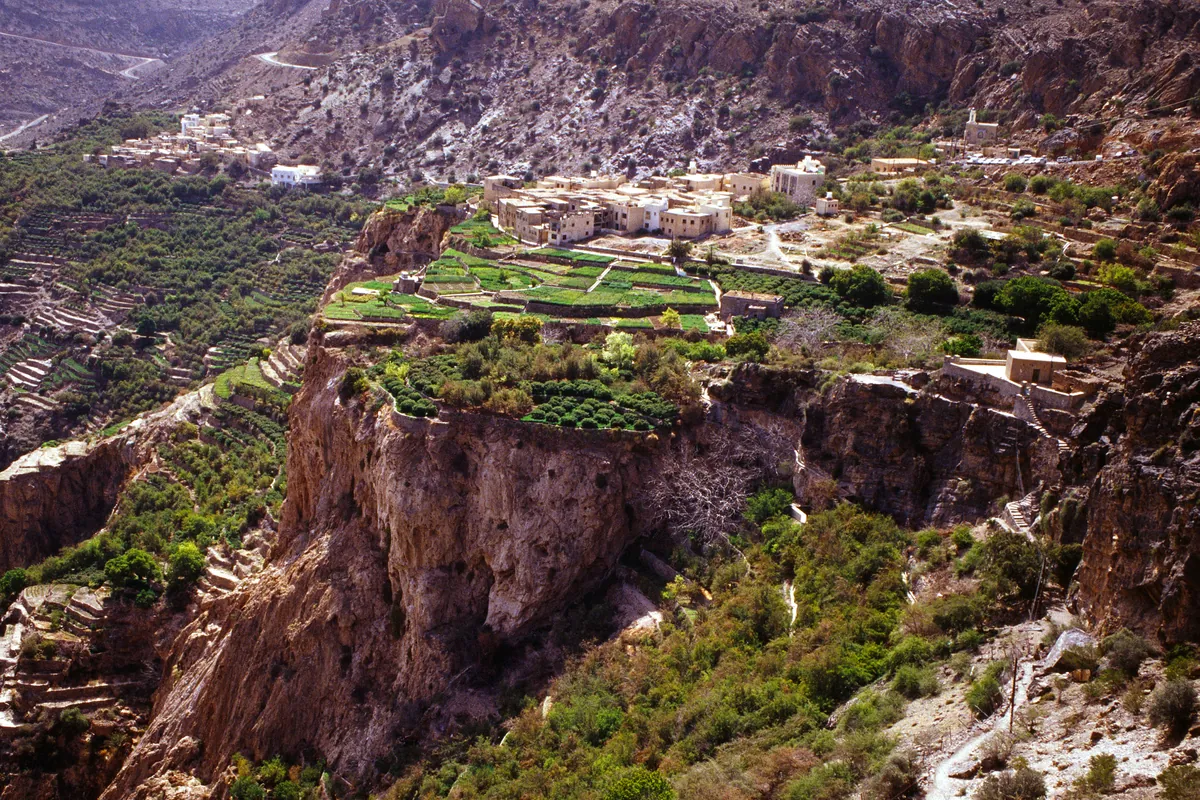
Jabal Akhdar adds a guided walk through falaj-fed terraced villages, a different day from the canyon-rim Balcony Walk at Jabal Shams. Add it only if that village contrast is worth giving up more Muscat time in the eight-day proposal—and Misfat's terraced walking, available on the route, does not give you enough of it. If that case is not clear, keep the single-mountain loop.
Photo from Wikimedia Commons
CONTENTS
Canyon Rim Versus Terraced Villages
Experience Oman puts the contrast simply: Jabal Shams is Oman’s tallest peak, known for sweeping panoramas and dramatic topography, while Jabal Akhdar, the Green Mountain, is about moderate temperatures and terraced farms. On a loop that already reaches the first, the second has to earn its place through the terraces, the villages and the irrigation that makes them work, not through another high viewpoint.
| Walk | Provider and route | Return format | Stated walking time |
|---|---|---|---|
| W6 Balcony Walk, Jabal Shams | Shams Adventure Tours; Al Khateem to As Sab along the Wadi Nakhr rim | Same path back; about 4 km each way | 3-4 hours on the trail for most hikers, including photo stops |
| Three Villages Walk, Jabal Akhdar | Travel Store Oman; Al Aqur to Ash Shirayjah through terraced farms | One-way; transport to the start and from the end not included, though it can be arranged | 3 hours for the guided walk |
The table’s times are the operators’ own estimates for the trail or guided walk, not for the whole outing. At Jabal Shams, the W6 route begins at about 1,900 m on the canyon rim, drops to about 1,700 m and involves roughly 200-350 m of elevation change. Shams Adventure Tours grades it easy to moderate rather than fully easy: the path is narrow and exposed in places, with steep, exposed sections near the ends and slippery shaded rock in cooler months. That mix makes the walk feel more serious than its distance suggests, and the operator’s advice—a local guide or small group, 2-3 litres of water, sturdy shoes—follows from it. The operator gives October to April as the season and suggests an early-morning start or an afternoon start from around 2:00 PM.
A second description of the Balcony Walk shows why the exact route matters. The Ministry-supported Wanderlust Explorer’s Guide to Oman, a 2025 reprint, calls the Balcony Walk a tough trek of about 5 km each way and allows a full day. It places As Sab along the way and a hidden lake further on, but names neither the trailhead nor the point where the 5 km ends, and it does not use the W6 code. Its full day is an outing allowance, not walking hours; without those endpoints, its distance cannot be matched to the operator’s round trip. Budget from the route you actually book.
On Jabal Akhdar, the appeal is not another rim view but the walk through terraces and villages. Travel Store Oman’s Three Villages Walk passes pomegranate, apricot and rose farms watered by falaj channels, with viewpoints over Wadi Bani Habib and its abandoned old village, and a local guide briefs the group at the start. The table’s one-way format is the practical catch: transport to the start and from the finish is not included, though the operator can arrange it, so the walk is only part of the Akhdar outing.
Anantara Al Jabal Al Akhdar Resort puts the Damask rose bloom from March to mid-May, and Travel Store Oman ties its rose-water distilling stops to April; the Anantara page does not say whether its distillery visit runs outside the bloom season. For an early-December day, plan around the terraces and villages, not around the bloom or the April distilling stops.
What the Extra Day Costs
The comparison only becomes real when you name what the Akhdar day replaces. The illustrative early-December eight-day proposal gives Muscat days 1-2, with a noon arrival on day 1; Nizwa and Jabreen on day 3; Al Hamra, Misfat and a Jabal Shams rim overnight on day 4; the Balcony Walk and then Wahiba on day 5; Wadi Bani Khalid and then Sur on day 6; Sur and Ras Al Jinz on day 7; and both Wadi Shab and Bimmah, followed by the Muscat departure, on day 8. Its Akhdar version compresses Muscat to day 1, puts the Grand Mosque and Nizwa on day 2, inserts an Akhdar day trip from Nizwa on day 3, and moves Jabreen into the Al Hamra-Misfat-Shams day 4. Days 5-8 are unchanged. The second mountain is therefore bought with compressed Muscat time and a rearranged fourth day, not with a spare day that does not exist. The proposal is a case to test, not a verified schedule.
That trade is harder than it looks. The Akhdar day trip contains the drive from Nizwa, the checkpoint and the transfer from Ash Shirayjah back to the start or onward, and no duration is given for any of them. Driving times for the Nizwa-Akhdar leg, the Al Hamra-Jabal Shams climb and the Jabal Shams-Wahiba transfer are unknown, so the shape of each day remains open. The three-hour walk has the clearest stated duration, and it is still only part of the day.
Misfat Al Abriyeen matters to the comparison because the original proposal already puts it, with its terraced fields and village trails, on day 4. The Wanderlust guide says trails around Misfat include beginner-level routes of just over half an hour and more challenging routes of around two hours, and describes a Sunset Walk that skirts the village edge into the terraced fields. Those durations come from a photo caption, the routes are not named apart from the Sunset Walk, and the Sunset Walk itself has no stated duration. Driving time is additional. Do not assume the Sunset Walk is the half-hour option. If Misfat already gives you the terraced fields and village lanes you want, Akhdar has to justify itself with its falaj-fed farms, guided one-way format and village viewpoints rather than with terraces in general.
A short keep-or-cut check makes the decision concrete:
- Which do you value more: extra Muscat time or a guided walk through Akhdar’s terraces and villages?
- If the mountain stays, what moves? In the tested version it is compressed Muscat time and Jabreen’s slot; if you cannot accept either of those changes, the Akhdar plan needs a different cut.
- Which logistics still need a time allowance? The Nizwa-Akhdar drive, the checkpoint, transfers to the Al Aqur start and from the Ash Shirayjah finish, and the Shams-Wahiba leg. Those transfer, checkpoint and arrival allowances are unstated, while the guided walk itself has a stated three-hour estimate.
Vehicle, Checkpoint and Overnight Checks
The two properties describe mountain access differently. Anantara Al Jabal Al Akhdar Resort states that Jabal Akhdar is reached through a mountain checkpoint, that a 4WD vehicle is required, and that the resort can arrange airport transfers and checkpoint transportation. That is a hotel’s access statement, not a police or road-authority rule. It does not name the checkpoint, describe the road surface or say which documents are checked, and it does not address rental contracts. A vehicle described as an SUV is not automatically 4WD. Confirm the actual drivetrain, the rental company’s permission for the mountain road and the transfer arrangement before you count on the Akhdar day.
Jebel Shams Resort’s information is a different kind of statement: the road to that resort climbs a steep mountain pass, and the resort recommends a 4x4 or high-clearance vehicle. It says nothing about whether the road is paved and does not address rental contracts, so treat it as a recommendation for reaching this property, not as the legal rule for the mountain. The relevant question for either mountain is the same: what does your rental agreement permit, and what vehicle will actually be delivered?
Overnight arrangements deserve the same check. Jebel Shams Resort gives check-in from 2:30 PM to 10:00 PM, check-out from 7:00 AM to 11:00 AM, and says the property entrance is closed from 10:00 PM to 6:00 AM. Those are that resort’s hours, not rules for every mountain stay, but they show why an arrival time should be agreed with the booked property. A late drive on day 4 or a delayed transfer can otherwise meet a closed gate or a reception desk that has stopped checking people in.
Winter at altitude is its own constraint. The Ministry-supported guide warns that Oman’s mountain terrain and high altitudes can send temperatures below freezing, and advises a warm jacket or fleece for winter camping or stays at Jabal Akhdar or Jabal Shams. That is general seasonal guidance, not a forecast. Check the date-specific weather and any access or closure conditions before committing to an early-December night on either mountain.
The Coast and the Flight Home
Days 5-8 are unchanged in both route options, but the coast is where the plan’s timing can still come apart. Ras Al Jinz Turtle Reserve states that night turtle viewing starts at 9:00 PM and that guests not staying at the reserve must be there by 8:30 PM; for guests staying at the reserve, room rates include dawn and evening viewing. The operator says timings may change with the season and asks visitors to reconfirm before arrival, and the operator’s page gives no December-specific schedule. If you are based in Sur rather than at the reserve, the 8:30 PM arrival is the constraint that shapes day 7. Reconfirm the start time instead of planning around 9:00 PM alone.
Within the day-8 plan, Wadi Shab offers two different versions of the visit. Experience Oman describes a short traditional-boat crossing near the entrance followed by a modest climb on trails past natural pools. Reaching the hidden waterfall requires swimming through a narrow cave, and basic swimming skills are necessary. The swim is optional, because how far to go is the visitor’s choice, so a shorter visit and the full waterfall trip are not the same commitment. The page gives no operating hours, boat fare, total activity duration or flood and closure information, which means it cannot tell you how much time to reserve on departure day. Decide whether the cave swim is for you, then confirm the current boat crossing and conditions before setting out.
Then work backwards from the ticket. If it shows a 12:00 AM departure, check which calendar date it belongs to: midnight is the first minute of the printed date, so the last usable evening is the one before. Work back from the airline’s check-in deadline, the car-return time and the actual road conditions, not from a generic airport buffer. Only then decide whether both Wadi Shab and Bimmah fit as proposed, or whether one stop should be shortened or dropped. The departure deadline, not the mountain comparison, sets the size of that final day.