Photo from Wikimedia Commons
Compare the full stay and transport cost, then weigh payment dates and cancellation terms. Before relying on a distance or shuttle claim, confirm how you will reach the Grand Mosque and return on your dates.
Photo from Wikimedia Commons
CONTENTS
Make the comparison on one basis
Set your dates, number of nights and guest count, and decide whether your budget is per night or for the whole stay. Compare actual offers in one currency, noting each room type and meal plan. Under Booking.com’s terms, you owe the stay’s cost, including applicable taxes and charges. Check which charges are included and which are payable separately so that each total covers the full amount due for the stay.
Booking.com treats a crossed-out price as a comparison with the same dates, policies and quality of accommodation, without the reduction. A lower figure based on a different room or meal arrangement, or on different cancellation terms, belongs to a different offer. Decide whether the saving is worth the difference instead of assuming the two are equivalent.
Payment and cancellation terms affect what you are taking on, not only the price. Payment may fall due before the stay, during it, or at both points, depending on the offer. Cancellation and no-show charges, and any refund, follow the provider’s policy for that booking: some rates offer no free cancellation, while others allow it only before a deadline. An earlier deadline can make a cheaper room the more expensive choice if plans change, so compare the terms as they differ.
For a Booking.com reservation, distinguish the accommodation provider delivering the stay from the booking platform, which Booking.com B.V. provides and is responsible for. Check that the confirmation sent to you and the provider has the correct guest names. When comparing direct, platform and intermediary offers, identify the accommodation supplier and who confirms the booking, then compare the payment and cancellation terms attached to that particular offer.
What a proximity claim actually measures
The three published claims below describe closeness in different ways. Each can help you shortlist a hotel, but none is a route plan.
| Hotel and area | Published claim | Decisive limitation |
|---|---|---|
| Elaf Bakkah, Al-Aziziyah (Mahbas Al-Jin district) | 2.4 km from the Holy Mosque | The advertised figure does not state how it was measured or which mosque point it reaches, and it is not verified as a walking distance or time. A separate reference to King Abdulaziz Gate does not establish a walking route, shuttle endpoint or current gate access. |
| Anjum Hotel Makkah, Umm Al Qura Street | “50 steps” to King Abdullah Gate, with private access for in-house guests | The step count is a marketing description, not a verified route or travel time; where the private access leads, its hours and accessibility are not stated. |
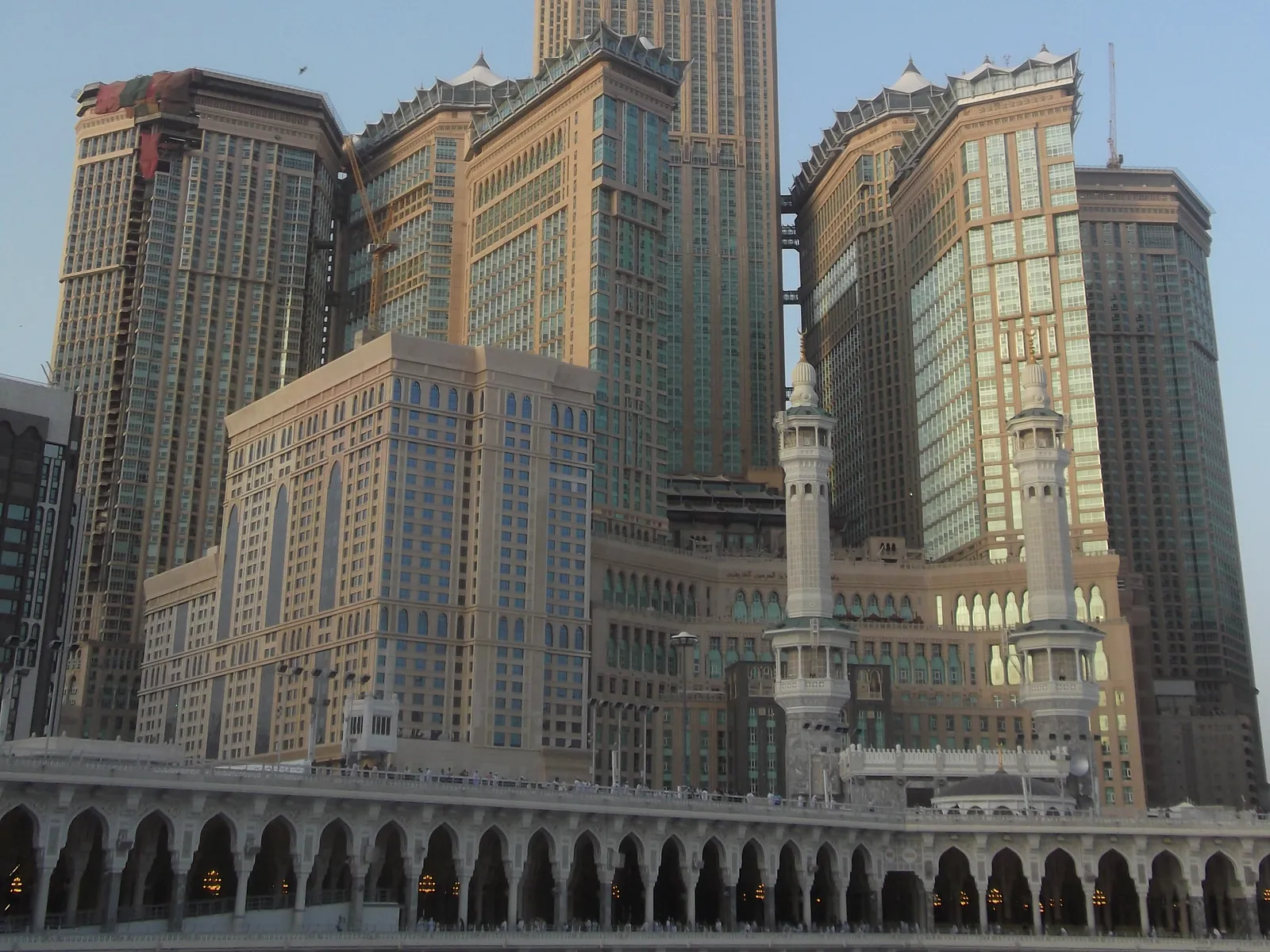
| Swissôtel Makkah, Abraj Al Bait complex | Private hotel entrances and a direct entrance through Ajyad Street | These are hotel-building entrances, not a named mosque gate; the page gives no walking distance or walking time. |
However different the claims are, they leave one practical question: which route from the hotel door reaches a gate you can use on your dates? Ask the hotel to confirm the route it recommends, the walking time, whether the route is accessible, the gate’s opening hours, and what to do if it is closed or crowded. Treat the answer as guidance for your stay, not a guarantee.
Evaluate a shuttle as a round trip
Elaf Bakkah advertises a free shuttle for its hotel guests to the Grand Mosque on an exclusive route, except during Ramadan. The Arabic property page otherwise describes the service as year-round for guests. A stay that overlaps Ramadan therefore cannot assume the free ride, and the pages do not establish what paid or alternative transport operates then—though that gap is not proof that transport stops. Nor does the exclusive route guarantee a traffic-free journey.
The pages leave the outward and return mechanics open and do not confirm that the shuttle operates on your dates or that the mosque access it uses will be available. Ask the hotel to confirm, for those dates, where you are set down and how far you then walk, when the service runs, where and when the last return leaves, and whether a seat must be reserved or paid for. If the free service will not be available on a date you are considering, add a clearly stated alternative, such as an estimated taxi fare, beside the quote; the comparison then rests on a known assumption. An unconfirmed arrival or return is a gap in the plan, separate from the room price.
On a short stay, a workable return can outweigh a small difference in room rate. A hotel with a confirmed schedule may cost less overall than a cheaper room that leaves you paying for a taxi back after the last return, once that journey is added. That is a judgement about your dates and itinerary, not a ranking of hotels. Compare the whole trip—the whole-stay room total plus the transport you can actually rely on—rather than the room rate alone.