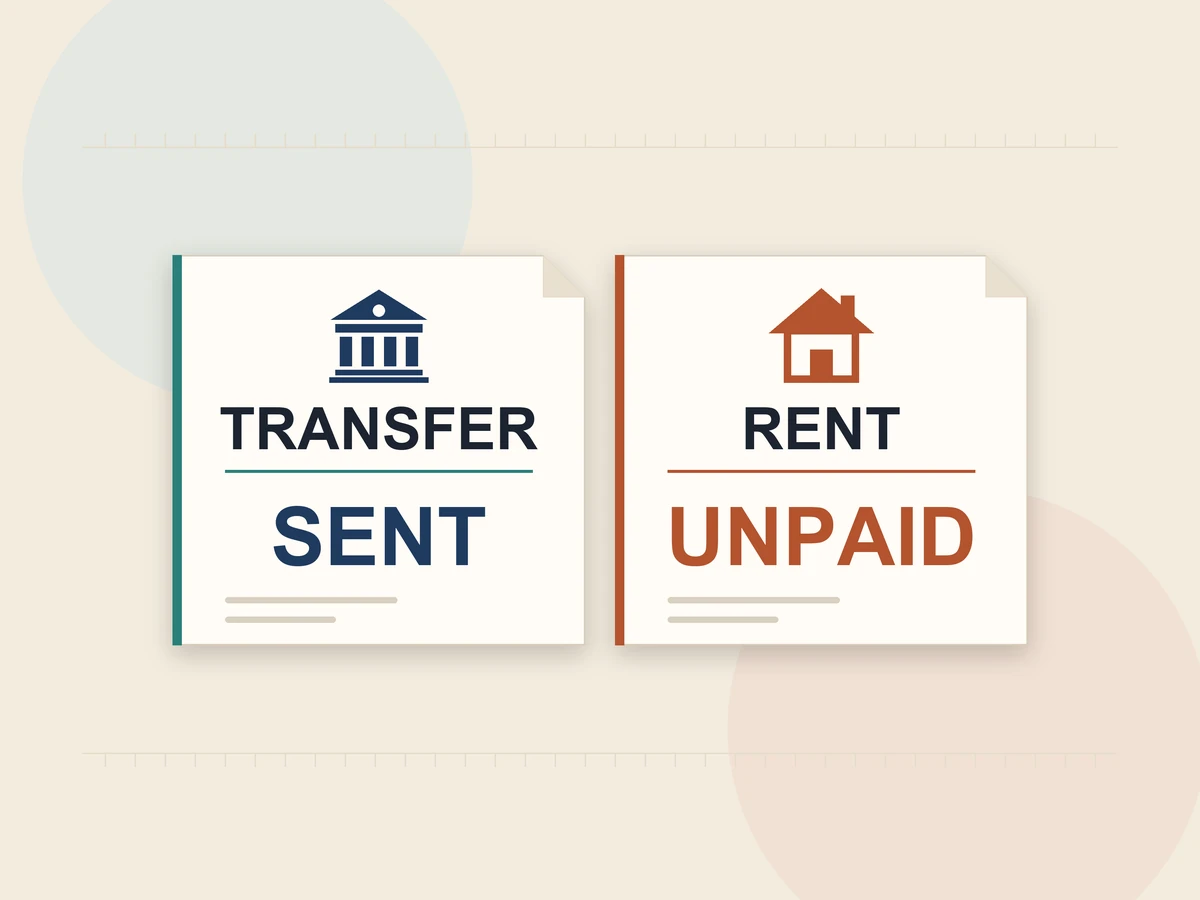
A bank transfer outside Ejar does not, by itself, confirm that the platform has recorded the rent as paid. Match it to the installment and contract records, then ask Ejar which confirmation or correction process applies.
CONTENTS
Match the Transfer to the Installment Ejar Shows Unpaid
Begin with the specific installment Ejar shows as unpaid. Compare its details with your bank confirmation and the relevant contract record. Keep any written instruction to pay a particular account, but distinguish that instruction from confirmation that the money was received or entered in Ejar.
Check whether the receiving name and account match the party and account in the contract. If the recipient is an office, company or another person, ask how that recipient is connected to this lease; the comparison alone does not establish whether payment was properly made. Note the contract’s recorded payment method as a separate detail. The next section explains the conditional receipt guidance and why the applicable process still needs confirmation.
| Record | What it can show | What it does not establish on its own |
|---|---|---|
| Bank transfer confirmation (date, amount, reference, receiving name) | That the money left your account on that date, to that recipient | Which Ejar installment was credited, or that anyone is authorized to credit it |
| Contract record in Ejar (contract type, start date, recorded payment method, lessor’s registered bank account) | The terms the lease was set up with, including the method recorded for payment | That rent was received, or that an off-platform payment has been recorded on this contract |
| The installment view in Ejar | The platform’s current position on that specific installment | That the underlying obligation is unpaid or paid, or who has to correct the entry |
| Receipt voucher, where one can be issued | A record of an off-platform payment against the contract | Availability: it turns on the recorded payment method and on lessor-side approval, and is not automatic |
| Written requests and replies, including any support reference | What was asked, of whom, and when | That a correction was made, or what follows from a refusal |
Use the matched records to ask Ejar how this transfer relates to that installment and what confirmation is needed.
Which Payment Rule Applies to This Contract
The Real Estate General Authority (REGA) announced a gradual restriction from 15 January 2024: rent for new residential lease contracts was to be paid through Ejar’s digital channels, mada or SADAD using biller number 153. Commercial lease contracts were excluded. The announcement did not define which contracts count as new, including renewals or re-concluded contracts. Present the contract’s type, dates and recorded payment method to Ejar for confirmation rather than treating those details as a complete classification rule.
The announced digital flow begins with the lessor and tenant documenting the contract through a REGA-licensed real-estate broker. After payment through the digital channels, funds reach the lessor’s account registered in the contract within five working days. That period concerns the digital transfer; it is not a discrepancy-resolution deadline or refund window. The 2024 notice also said REGA would gradually stop issuing electronic receipt vouchers for new residential contracts and described automatic settlement of digital-channel payments without one. It gave no end date for that gradual arrangement, so it does not establish the present stage of the change or this contract’s current receipt settings.
For covered new residential contracts, REGA stated that off-channel rent-payment proofs would not be relied upon; its English notice says they would not be recognised as valid proof of payment. Keep that recognition statement within its scope. The notice does not decide the judicial weight of a bank transfer or explain how money already sent to a lessor or office is recovered or credited. It is not a determination that the tenant owes the rent twice or can ignore the amount.
Ejar’s customer-service replies describe a conditional receipt-voucher route, not every possible way of correcting a platform entry. The 2026 replies associate a voucher with a contract whose recorded payment methods permit it and with the lessor’s approval. The visible February 2026 reply says that a voucher cannot be requested where electronic payment is the contract’s only method. These case-dependent answers do not establish a universal tenant-account procedure; confirm the process and roles for this contract.
A February 2024 reply described a different premise: a contract already in force before platform payment became mandatory. It allowed transfer to the broker or lessor, or cash, subject to requesting an electronic receipt voucher. That individual answer does not establish how every earlier contract or later renewal is treated today. Nor does the mention of a broker establish that any office account is an authorised recipient. In September 2025, Ejar described lessor or broker issuance for contracts not limited to electronic payment, while the 2026 replies referred to lessor approval. These statements do not establish which tenant account can initiate a request or whether a broker’s action replaces that approval.
Ask who can initiate and approve a voucher for this contract, and what Ejar requires if the request is refused or ignored. If the contract is electronic-payment-only and money has already gone outside the platform, ask how that particular discrepancy should be handled. The supplied guidance establishes neither a remedy nor that another transfer is the answer.
Ending the Contract and Handing Back the Unit: Separate Records, Separate Questions
When a tenancy ends, three records are often treated as one: the contract’s recorded status, the financial settlement attached to ending it, and the condition record made when the unit changes hands.
The December 2024 Ejar services guide describes a mutual termination request for documented residential or commercial contracts. Either the lessor or tenant may submit it; the other party approves or rejects it. The request includes an end date and a financial-settlement selection covering all payments or the final payment. In that guide, approval leads to Terminated status, while rejection leaves the contract Active.
A settlement selection is easy to over-read. The December 2024 guide describes the selection as covering all payments or the final payment, but not who pays or receives an amount, any refund, or the calculation behind it, so the selection is not itself a statement that money moves in either direction. How it treats installments that were already unpaid, and the position where no termination was recorded at all, are points to confirm against the ledger.
Handover is a third record with a different subject. The Ministry of Municipalities and Housing describes electronic unit-condition records at receipt and handover, completed and approved by the contract parties on the Sakani platform, and states that the service began voluntarily in the residential sector; its description does not establish that the service is now compulsory. What the form documents is the state of the unit — it is not a statement that a contract ended or that rent entries were settled.
For a tenant who has left or is leaving, the useful checks are the current contract status and any recorded end date, whether a termination request and its settlement selection are recorded and approved, and the handover and message history. Together those records show what the contract currently records and what the settlement was recorded as covering. Whether the specific installment still showing unpaid is affected by that, and what confirmation would settle the question, is what to ask Ejar or REGA rather than assume from the end date.
What to Ask Ejar or REGA, and What the Answer Needs to Cover
For questions about the platform record, REGA’s December 2024 Ejar guide lists 199011, info@ejar.sa and @ejar_sa; REGA’s FAQ also directs Ejar enquiries to 199011. Its contact page offers separate enquiry, complaint-and-suggestion, and report routes. Ask which route handles the ledger discrepancy or your concern about a broker’s conduct, and keep the reference you receive. Those listings do not identify the right route for this particular case or promise that the entry will be changed.
Using the records from the first section, a short written enquiry travels further than a long complaint. The questions that matter here are:
- Which payment method is recorded on my contract, and what process does Ejar use to record an off-platform payment on a contract like this?
- Who may request a receipt voucher for this contract, and who must approve it?
- How does this transfer — date, amount and recipient — relate to the specific installment still shown as unpaid?
- If the money went to an office or a third party’s account, or a receipt request was refused or went unanswered, what route applies and what confirmation is needed?
- What are the recorded contract status and end date, and what effect, if any, does the recorded settlement have on the outstanding entry?
Ask for the answer in a form you can keep: a written reply, a case or ticket reference, and the rule or procedure relied on. That is advice about building a file, not a promise that a channel will change the entry.
Two conclusions are worth avoiding. The restriction described above does not mean a covered off-platform payment must be paid again, and it does not mean the entry can be ignored: how money already paid outside an electronic-only contract is handled, and what follows from a refusal, are open questions rather than settled ones. If the amount is disputed or a formal demand has arrived, the same file — contract record, transfers, messages, platform screens and any end or settlement record — is what to put before qualified legal advice in Saudi Arabia, rather than guessing how a transfer would be assessed.